

What happened when the last good Shakey's Pizza lost it's name
An Inland Empire restaurant bereft of its brand undergoes an existential crisis, discovering a second act as a venue for local punks and poets

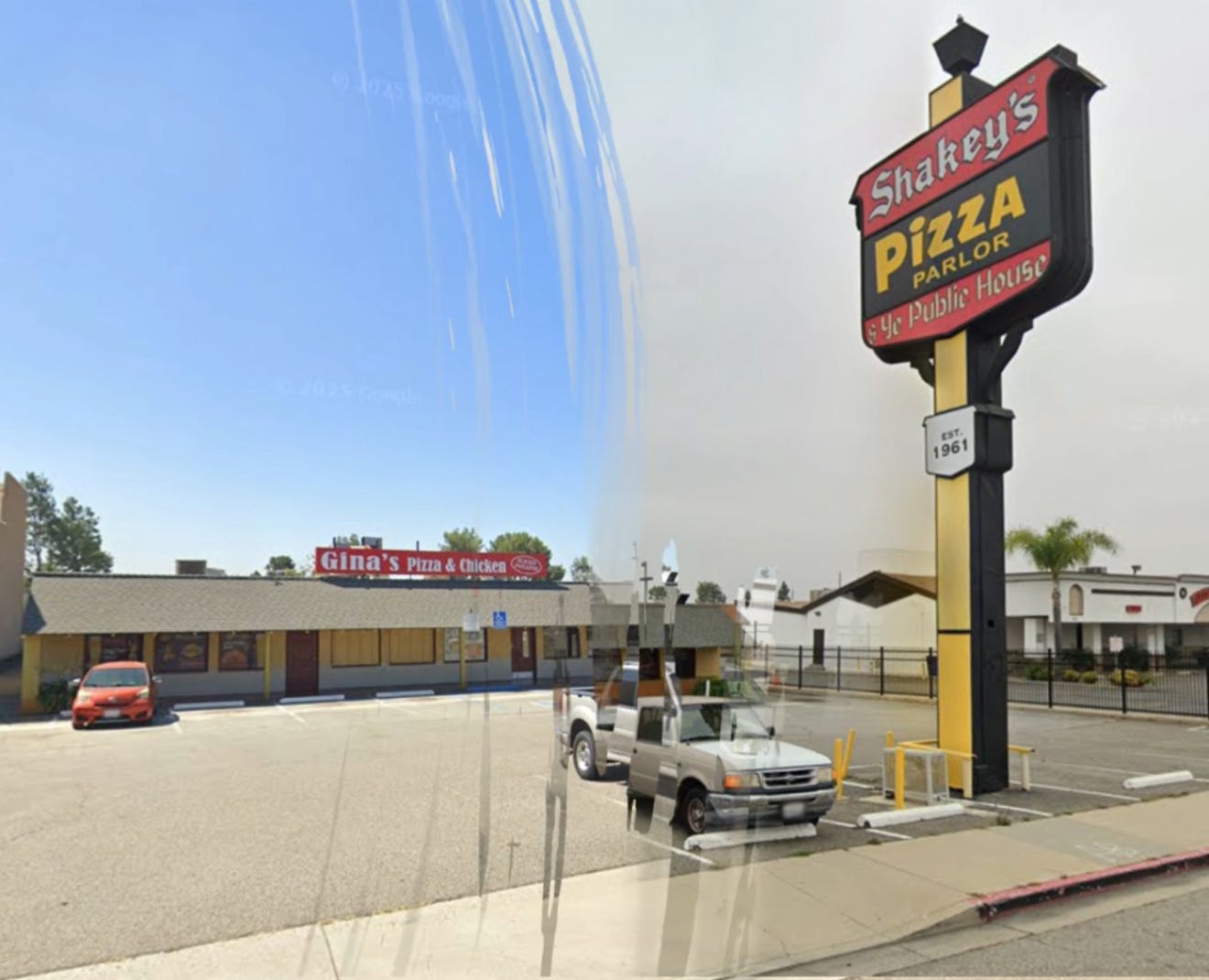
BREAKING NEWS: Shakey’s Pizza on Holt Boulevard in Montclair, California, has ended its franchise and now operates under the name Gina’s Chicken and Pizza (also known as Gina’s Pizza and Chicken).
I assure you it’s a big deal around here. There are Facebook and Nextdoor posts with dozens of comments employing no fewer than three question marks. The local chamber of commerce has assembled via luncheon to spread the word. Even a local council member, reportedly a huge fan of Shakey’s growing up, saw fit to issue a clarification via social media.
Nothing has changed about the staff and recipes, said longtime assistant manager Gina Amir. But after the owner passed away earlier this year, they couldn’t afford the license any more. Google users reported the restaurant as a permanently closed Shakey’s Pizza. And until they can get properly listed, they’re stuck in a strange purgatory, between Shakey’s and not-Shakey’s, digitally closed but physically open.
The reaction to this news was not mild. The Montclair Shakey’s happens to be the oldest location in Southern California, established in 1961 and outlasting wars, recessions and a pandemic. Customers had multi-generational relationships with the food and grew very accustomed to having it available. When the brand went away but left the food and staff behind, a kind of bizarre reckoning began.
Grieving diners, seeing their beloved Shakey’s closed on Google, barged in to demand answers.
Gina always explained about the franchise status and insisted that nothing about the restaurant had changed. Not the pizza, nor Gina, a Shakey’s employee for nearly two decades who had watched many of these customers grow up.
But people were understandably frustrated by the lack of clarity about whether or not this was currently a Shakey’s. And it was a difficult question to answer, one that had become nearly philosophical in nature.
The Shakey’s name was gone, but Gina - the woman who had presided over their soccer team post-game meals; who could ask about their parents by name; who had seated them in the booth with the good lighting for their first dates - was still here. And so were the pizzas, fried chicken and mojo fries.
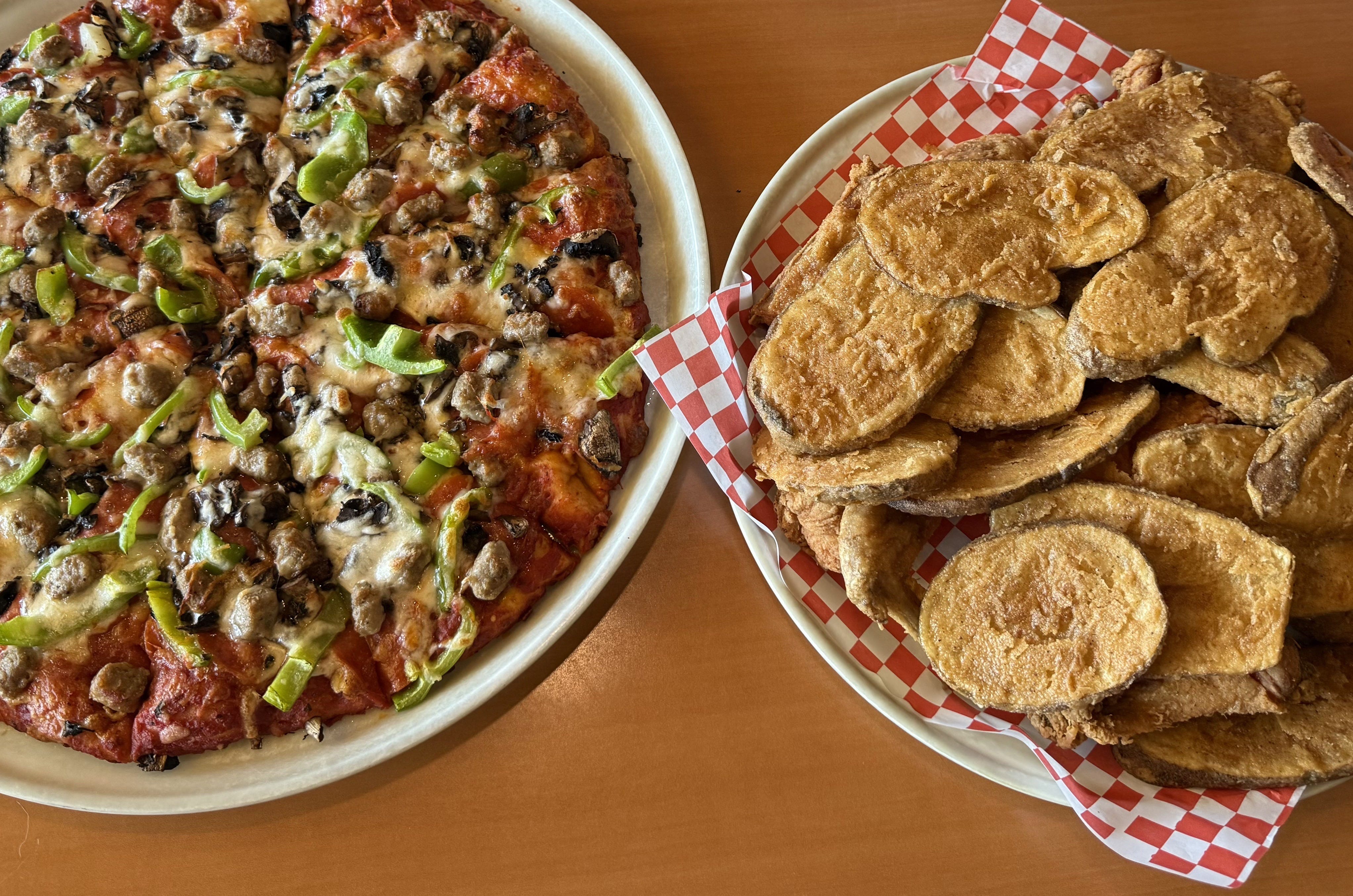
At this point, confused still but their outrage somewhat dulled by the lack of a target, the customers would typically order food to go, promising to return if it was still the same. Which of course it was, because nothing had changed about the restaurant except some paperwork.
Gina has had a hell of a time getting the word out. And she’s not having such an easy time with the adjustment either. She still wears the old uniforms with a piece of tape over the new logo.
“People really loved Shakey’s. They loved this food,” Gina said.
There are no culinary miracles happening at any Shakey’s Pizza. But Gina told me of a a family whose grandfather insisted on holding every gathering at this particular Shakey’s.
After he passed away, they kept the tradition even after moving to Hesperia, more than an hour away by car. That drive takes them past at least four other Shakey’s locations their grandfather had deemed inferior, and to honor his memory, they do as well.
At this point we need to discuss a uniquely Southern California urban legend simply known as “the Good Shakey’s.”
This is a mythical location of the Sacramento-founded chain where the food and service is rumored to be of markedly higher quality. It is a magical land untouched by late-capitalist cost-cutting, where the pizza at the buffet is always fresh and the mojo fries are slices of actual potatoes, not reheated potato products.
There are more than a few theories as to which Shakey’s is the good one. If there were ever a conclusive frontrunner, the truth has since been buried under a weight of rumor and hearsay that would take months for a team of reporters working full time to sift through. This individual reporter, working alone, has learned that for many people in this particular area, the Montclair location was the good Shakey’s of legend.
There could be a lot of reasons for this. But Gina thinks it’s because the restaurant’s older layout predates many of the standardizations adopted when Shakey’s became a larger chain.
Large freezers were never installed because there isn’t room. They prepare the food in open kitchen that also houses the cash register and the point of sale. They’ve always made the mojo fries and pizza from scratch, even after most of the other Shakey’s started used standardized frozen products.
But, the Shakey’s corporate office has not returned my requests for comment, so I can’t be certain if there was ever truth to the rumor.
There were once 450 Shakey’s locations across the land, known for live music, pizza, arcades and an all-you-can-eat buffet. Now they’re down to 43 locations, all in California except one in Washington State. They’re sustained by a largely immigrant and Latino customer base. The chain even enjoys a second life in the Philippines where there are more than 300 locations)
This summer, Shakey’s launched a nostalgic rebrand, unveiling a new flagship location in Culver City with the hopeful slogan “The People’s Pizza Parlor.” They’re targeting elder millennials and Gen X’ers with updated decor like ET movie posters and Indiana Jones lunch boxes.
But it’s not hard to see why the myth of the good chain location persists in an age when most of these businesses are managed by private equity or people answering to it.
It’s something happening all around the economy. At airports, grocery stores and restaurants, customers are swallowing drastic downgrades to familiar experiences. Panera Bread most recently cut staff and raised prices while reducing portion sizes.
Perhaps the myth of a good Shakey’s contains genuine memories of a time when chain corporations struck a more reliable bargain with American consumers.
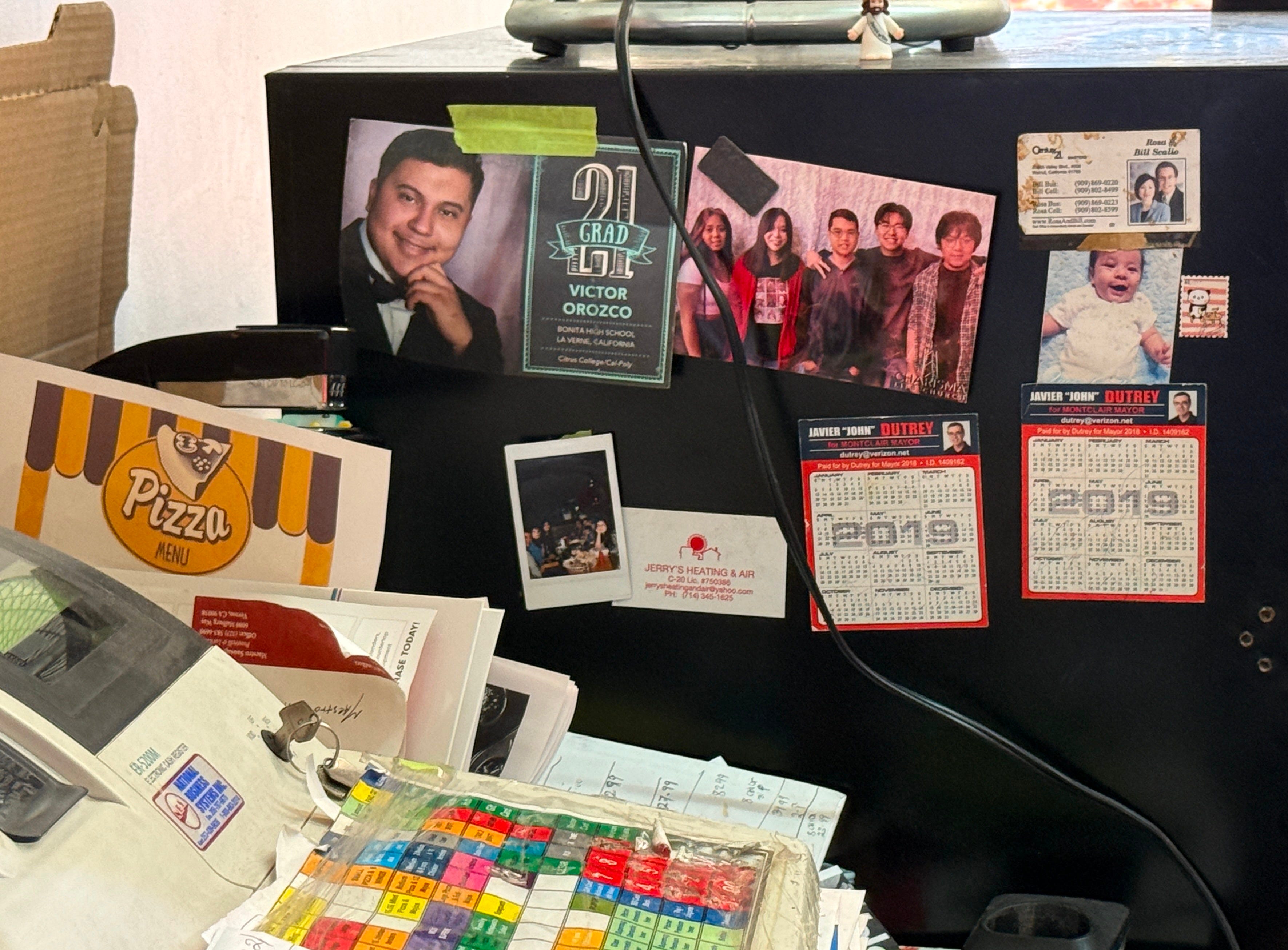
The Inland Empire has always been something of a heartland for American chains. People here remember Taco Bell, McDonalds, Del Taco and In-n-Out before they went corporate because the original locations opened just a few towns over. Locals came to trust chains here, for better or for worse. It’s the kind of place where a $15 soup and salad bar is not just a deal but something approaching a covenant.
That covenant is what’s truly valuable about restaurant chains, and it’s a big reason why private equity has targeted so many for short-term profit extraction. That trust is built slowly. It can’t be bought with branding, recipes or suppliers. It’s made of people like Gina, showing up every day, memorizing names and dates of birthdays, weddings and graduations.
I have a theory about why Holt Boulevard was considered the good Shakey’s: it’s people like Gina. These days she’s one of the main reasons that fans of the old Shakey’s can walk in and still recognize the experience.

Gina knows she’ll probably never reconnect with all of her Shakey’s customers, who have likely decamped to another nearby location. But she’d like them all to know this restaurant is still here.
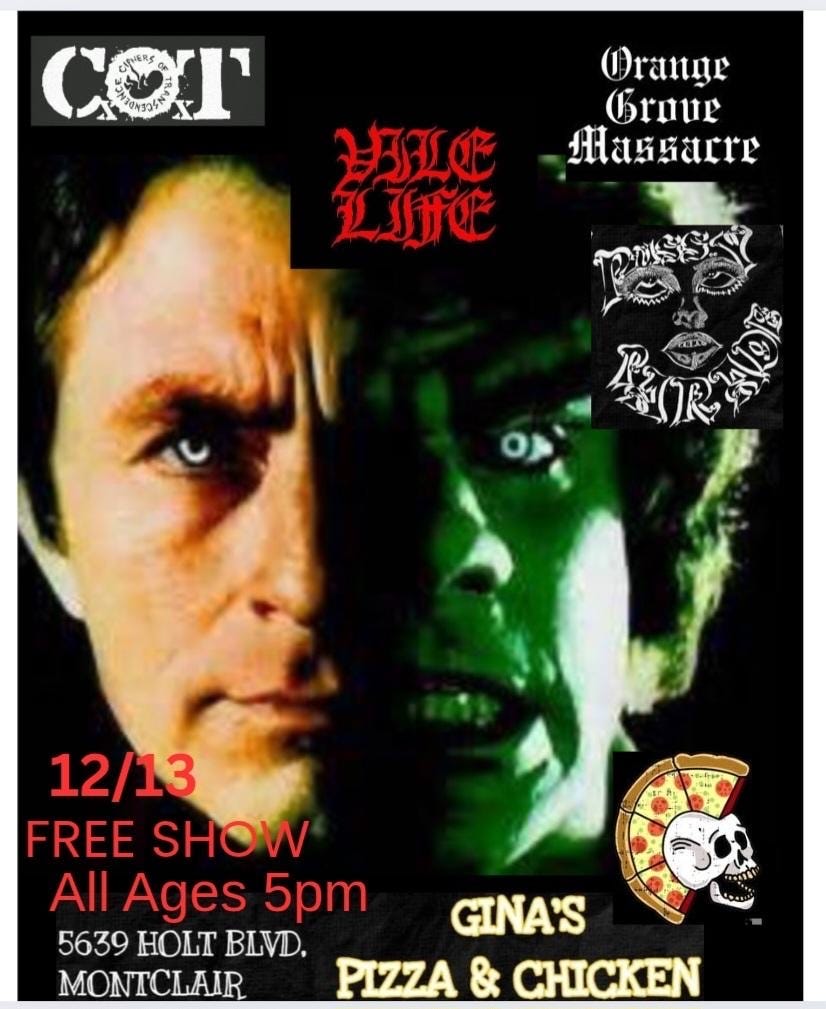
And Gina’s Pizza and Chicken is starting to forge a new covenant with the community. The dining room is finding a second life as a venue for punk concerts, poetry readings and other hyperlocal events.
I promised that I’d help spread the word, and like I said up top, this is a breaking news story. So I would be remiss if I did not inform you that ton December 13 the restaurant is hosting an all-ages punk show taking place at 5 p.m. (flyer below).
The good Shakey’s might gone, and maybe it never existed. But Gina’s Pizza lives on.