

Night Train to Tokyo
Boarding Japan's last regular sleeper express in search of ekiben origin stories


OKAYAMA, Japan—It’s near midnight at Okayama Station and I can’t figure out why everyone else on the platform has gotten so quiet.
Pneumatic squeals pierce the silence. People start to jostle me and thrust cameras into my view. I box out with my own phone but I can’t figure out what to shoot. All I see is another train inching towards us like an expectant bride.
I stifle a laugh as I finally realize what’s happening: the trains are about to kiss and everyone wants a picture. This is the nightly docking ceremony of the Sunrise Seto, an overnight express train to Tokyo. I decided to bear solemn witness to the moment, which was clearly awash in cultural significance wasted on me. Footage below:
This 7-hour train ride is the end of the first leg of my ekiben travels in Fukuoka and Osaka, and it’s the first sign of mission creep.
I came to Japan to attend to one obsession, ekibens, and I didn’t budget for another. But a carpeted bunk on the Sunrise is free with the Japan Rail Pass and you can upgrade to a tiny cabin for a small fee.
It was a good deal, but I still can’t afford to become a train person, I tell myself, folding my legs into the cabin and tearing into the day’s ekiben. There’s a vintage amenities console with air conditioner, night light and a button labeled “NHK,” which pipes the Japanese national radio service into the cabin. I punch it and catch a Beethoven symphony at the end, the announcer’s summary a compact, dulcet purr in my ear.
I’ve had nothing but train bentos for past week, except a bowl of tonkotsu ramen in Fukuoka. Spirits are high but I’m spotting some repeats: Tamagoyaki, kinpira gobo (braised burdock root and carot), stewed lotus root a rice topping of shredded, seasoned eggs
Osaka ekiben feature kushiage, meats and vegetables battered and fried in egg and panko. There was also an eel egg ekiben arranged to resemble Himeji Castle.
Fukuoka ekiben are famous for salty sacs of spicy marinated cod roe called mentaiko, including one bento in collaboration with the Pikmin video game series.
For the ride, I picked up this “Keihanshin” bento, named for the metropolitan region encompassing Kobe, Osaka and Kyoto, featuring flavors from all three.
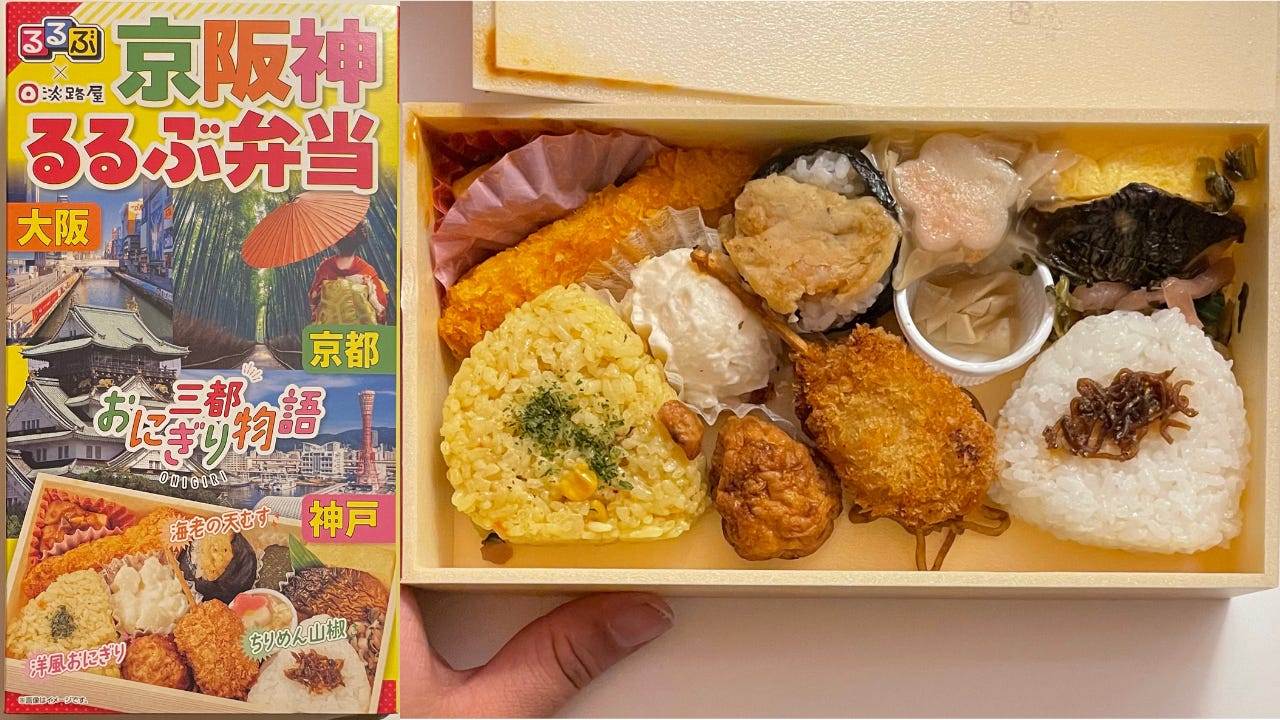
There’s no one else in my coach, and the next cab over is a small unmanned cafe with vending machines and two sets of bar seating facing the windows with outlets.
I plug in my laptop and devour the scenery - what little there is, hurtling through the Japanese countryside on a moonless night. This is my first sip of the heady brew that is train nerdiness, and despite my best efforts, I’m getting absolutely plastered.
What I loved about ekiben was also what felt so intriguing about trains. Both invoked this intoxicating myth of something vast and complex made knowable and orderly.
And it felt especially good to be on a train, a month into Donald Trump’s second inexplicable presidency, with Los Angeles smoldering and the journalism industry entering another death spiral. The last few months have cast a lot of doubt on the idea that progress is a triumphant arc bending towards justice. Right now it’s more like a volatile stock price or sputtering EKG, whichever shape makes the richest people more money.
But trains are from that era when everyone believed that progress had but one vector: forward, everlastingly. National rail networks democratized travel around the world and symbolized each nation’s triumph over nature.
And train rides, lasting hours to weeks, bred a culture of elaborate hospitality that eventually became rail travel’s primary attraction. Moving mansions with not just bedrooms, but parlors, smoking rooms and bars. Restaurants created menus that matched the scenery, incorporating local, seasonal and exotic ingredients thanks to the reach of the rail network. Riders competed for seating times that would pair the best food with the best views.
Train cuisine was born in this decadent liminal space. American Pullman dining cars served steaks, seasonal seafood and regional specialties like gumbo. In Europe, the famed blue coaches of the Wagons Lits dished up foie gras, smoked salmon, wines and cheeseboards.

And for Japan, it was train bentos.
Bento began as techniques for preserving food for long journeys. The word stems from an archaic Chinese word for convenience, biandang, which was later ported back into Chinese with the Japanese definition, boxed lunch.
It’s a cuisine specialized for consumption on the go, at room temperature. Textures, tastes and smells must be pleasurable even when cold, which requires different pairings and preparations of traditional dishes like the beef domannaka ekiben, a version of gyudon with less moisture and concentrated sauce.
Traditional containers for bento used naturally antibacterial materials like bamboo leaves, bark and persimmon leaves. Pickles nestled in beds of rice acted as natural preservatives.
Ekiben have been popular for over a century - a study found annual consumption reached 100 million units in 1924. During war, train bento shops helped feed starving citizens and ekiben wrappers sometimes featured prints of propaganda materials. Imperial Japan also imported ekiben to each of its conquered territories, which is why you’ll find so many in my family’s home country of Taiwan.
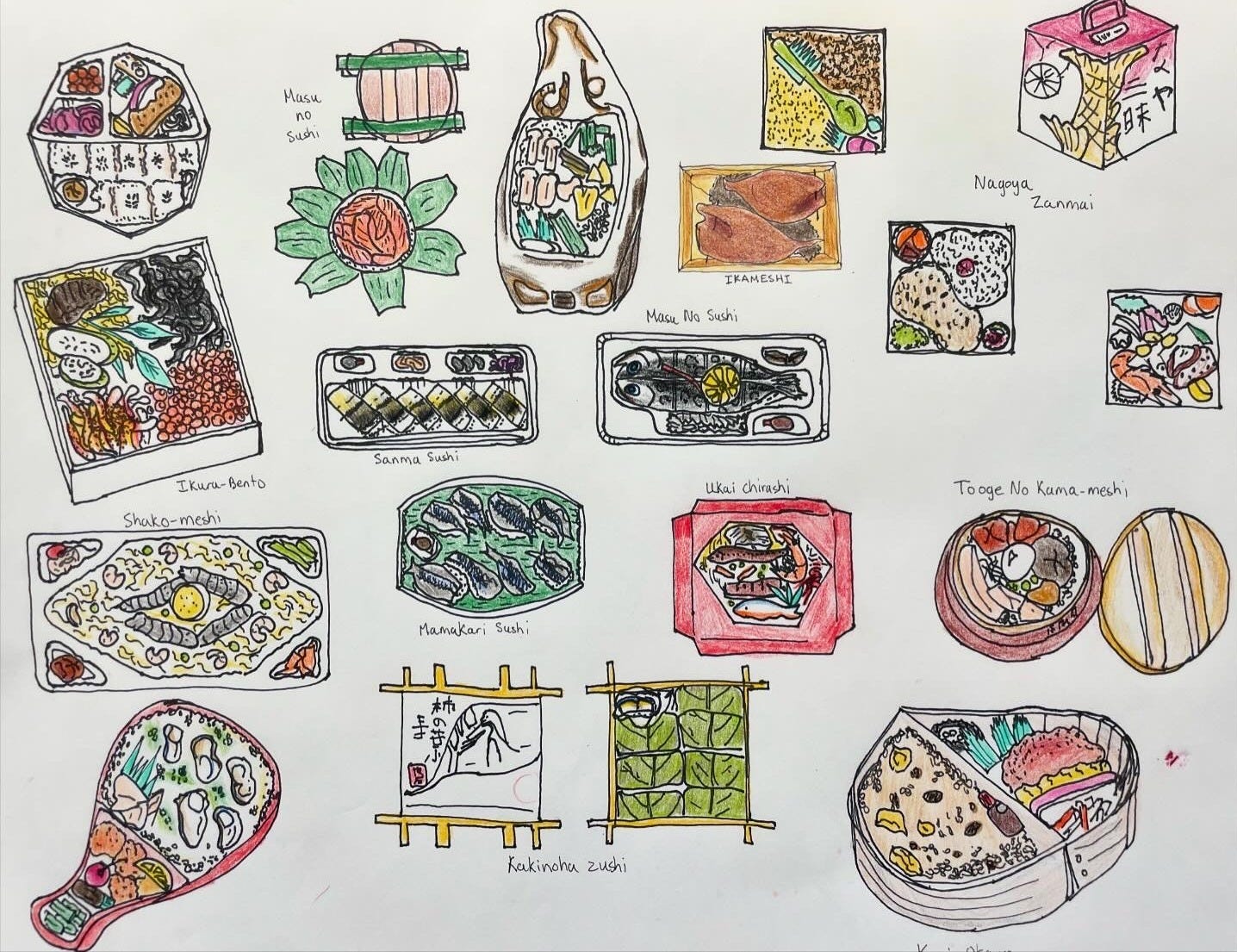
Ekiben peaked in the 1960’s, when there were between 3,000 and 5,000 kinds of ekiben available produced by around 400 different ekiben companies, researchers found. Many ekiben reflect ancient and regional food practices, but an equally significant number were created to pump ridership to for new railways and stations.
The massive menu testifies to the thwarted political ambitions of Japan National Railways, the former state-owned train authority that was declared insolvent and privatized in 1987 after accruing $87 billion in debt. The Liberal Democratic Party needed rural votes and demanded new train lines to remote areas even as those lines posted record losses.
Ekiben flourished as JNR floundered. The Keio Department store ekiben tournament I wrote of earlier launched the same year JNR issued bonds to pay interest on previously issued bonds (the state’s version of taking out a credit card to pay interest on another credit card).
Ekiben’s growth came as rural towns across Japan were embracing a new economic initiative called One Village One Product. Small towns, bleeding population and jobs, began to coordinate their output so that each town could claim a specialty that might become it’s own tourist draw.
Ekiben were the perfect vehicles for these new products, which became beloved by a generation of riders discovering the first pangs of furusato, or hometown nostalgia. Train lunchboxes became essential cogs in a regional cultural marketing strategy so successful that versions of it spread to Thailand, Africa and the Middle East
One Village One Product pioneered in Oita Prefecture in 1979. All 58 municipalities took part, developing 766 different local products in just two decades; Shiitake mushrooms, Kabosu citrus, horse mackerel and Oita wagyu beef, among many others. By the year 2000, the initiative had helped double the prefecture’s per capita income to 2.4 million yen, a little over $16,000.
And here at last was a convincing origin story for Japan’s myriad, labyrinthine cultural rabbit holes that had monopolized so much of my attention. This overwhelming abundance of regional and cultural specialties are, at least in part, the products of a highly successful rural stimulus program.
The strategy has been picked up in Thailand, Africa and the Middle East, and its principles form the backbone of a United Nations Development Program measure called One Country One Priority.
Are these products truly organic expressions of culture, if they were created systematically, their manufacture incentivized by governments to stimulate flagging rural economies? I think the answer depends on what meaning the people invest in ekiben, meibutsu (famous regional culture) and tokusanhin (regional delicacies). It’s clear a lot of these regional specialties and cultural practices existed long before the initiative.
“One village, one product” helps explain why trying to taste all of Japan’s regional ekiben feels like a an endless game of whack-a-mole. But learning of the artifice behind ekiben only deepens my appreciation.
Today the Ekiben Company partners with the six privately owned Japan Rail companies to operate a dwindling number of ekiben kiosks. The agency stamps official train bentos with a seal and recognizes about 150 member organizations. Sales have been declining since the 1970’s and faced a serious existential threat during the pandemic. Many stations have closed or consolidated their platform kiosks and at many, I couldn’t find any ekiben for sale.
The shops that are left are still crowded every time I visit, but travel influencers now steer tourists to the nearby underground mall food courts instead. These serve hot bentos next to regional foods and gifts popular with travelers in larger spaces.
It’s not like ekiben are about to disappear entirely. But the evidence of its inevitable decline fills me with a sharp, sweet ache. And I can finally understand what brought the train guys to a freezing platform on a weekday night to photograph two traincars kissing. Trains can carry us forward but they’re just as good for transporting us to the past.
I wish I knew what memories the train guys were chasing. For me there’s a particular scene in the film Kiki’s Delivery Service. It’s a film about an industrious young witch Kiki and her black cat Jiji who leave home to start a new life in a city. I first saw it as a high school graduate, the summer before leaving home in Tennessee to start college in Los Angeles.
Filmmaker Hayao Miyazaki, in interviews, said Kiki represented a generation of Japanese girls leaving the countryside for jobs in big cities. It was a migration enabled by new railroads, and that’s probably why the film starts with a scene of Kiki getting on a train.
The girl and the cat cruise through the clouds with a radio tied to her broomstick. A storm forces them to shelter in a passing train car full of hay. They dry off, burrow into the straw and doze off in the middle of their conversation. Moonlight races across Kiki’s face in rhythm with the clattering of the tracks.
They don’t know where the train is taking them, but they’ll know it when they get there.
The opportunities offered to Japanese young women are very similar to the opportunities provided by industrialization in America and immigrants from Europe to America - you had a chance to leave home, be invested in, have privacy (a room of one’s own Virginia Woolf), make some of your own decisions (Brooklyn, colm Toibin) deprioritize marriage and child bearing, send money to your family, learn a new skill, form opinions of your own.
I have actually never seen this famous Japanese movie! I wonder why this director always chose young female protagonists. Maybe he is trying to support someone 🥰
*kinpira gobo is my favorite Japanese homemade meal!! Please save your discarded parts and parcel to me!! Haha
Frank, this is so good. on so many levels.